Paper Submission Deadline Extended!
The paper submission deadline has been extended to , Anywhere on Earth (AoE). Submit here.


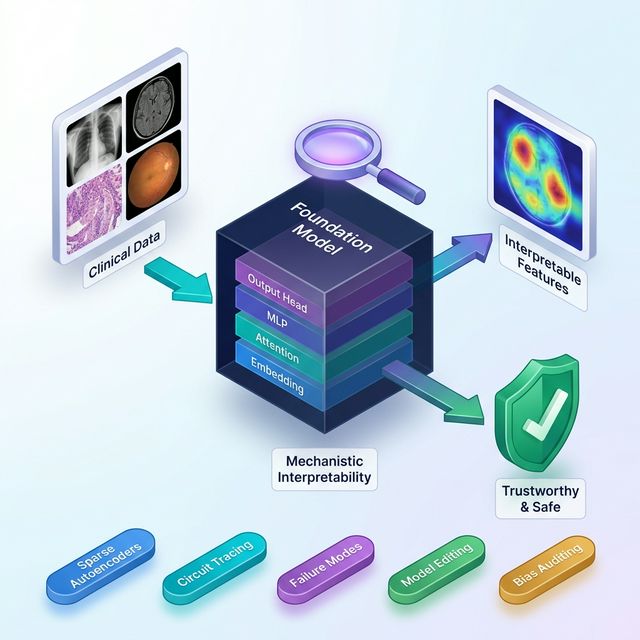
MI4MedFM is a workshop held in conjunction with MICCAI 2026. It focuses on understanding how medical foundation models compute, where they fail, and how mechanistic interpretability can make them safer, more robust, and more reliable for clinical deployment.
Deadline extended Paper submissions are due (AoE)The paper submission deadline has been extended to , Anywhere on Earth (AoE). Submit here.
We are excited to announce that the MI4MedFM submission portal is now officially open on OpenReview. We look forward to your innovative contributions! Submit here.
The official website for the MI4MedFM workshop at MICCAI 2026 is now live. Call for papers and important dates have been announced.
MI4MedFM has been officially accepted as a workshop at MICCAI 2026 in Strasbourg, France.
Medical foundation models are becoming central to imaging and multimodal clinical AI, but high-stakes deployment needs more than saliency maps or attention plots. MI4MedFM centers mechanistic interpretability: understanding the internal computations that generate model behavior.
The workshop creates a focused MICCAI forum for methods such as sparse autoencoders, circuit discovery, activation patching, causal tracing, steering, and weight-space analysis — while keeping the discussion tightly connected to clinical validity, robustness, and deployment safety.
Our scientific agenda is structured around four interlocking goals that translate mechanistic interpretability into robust clinical practice.
Understand what features, subcircuits, and latent representations medical foundation models rely on when producing clinically relevant behavior.
Hover over the foundation model representation below to expand the hidden layers and inspect the mechanistic computations driving clinical predictions.
We welcome submissions across a wide range of themes bridging foundation model interpretability with safety and deployment.
Methods that uncover what medical models internally encode and how those computations are organized.
Tests that determine whether discovered mechanisms align with trusted medical concepts and downstream behavior.
Mechanistic debugging for brittle reasoning, domain shift, bias, and unreliable multimodal outputs.
Using mechanism-level insight to improve robustness, correct behavior, and reduce harmful failure modes.
Interpretability-guided monitoring and uncertainty-aware signals for safer clinical deployment settings.
Frameworks and workflows that make mechanistic analysis practical for medical imaging and multimodal MedFMs.
A focused 2-hour program featuring a keynote, oral presentations, and an interactive poster session with networking.
An invited talk framing trustworthy medical AI through the lens of mechanism and evidence.
Selected papers presented in concise oral sessions built for cross-disciplinary accessibility.
Poster-first visibility, direct discussion, and opportunities for clinicians and ML researchers to connect.
Celebrating the best paper and best presentation awards towards the end of the event.
Setting the agenda, scientific motivation, and workshop goals for the MICCAI audience.
Flagship invited talk on trustworthy medical AI, interpretability, and clinical reliability.
Curated short talks presenting methods, evaluations, and lessons for medical foundation models.
Announcement of the Best Paper and Best Presentation awards, followed by concluding remarks.
Poster interaction, demos, and in-depth discussion around methods and applications.
We are honored to feature a leading pioneer driving the future of trustworthy and transparent clinical AI.
We invite original research contributions on mechanistic interpretability for medical foundation models. Submissions are welcomed across two tracks.
(AoE)
August 7, 2026
August 12, 2026
September 27, 2026
Original, unpublished research intended for the MICCAI satellite-events LNCS proceedings.
Extended abstracts, previously published work, or work currently under review elsewhere.
Use the official Springer LNCS LaTeX template
Double-blind with conflict-of-interest safeguards
Relevance, rigor, clarity, validation, and reproducibility
Our international committee unites expertise in medical image analysis, foundation models, and trustworthy artificial intelligence.

Associate Professor
MBZUAI
Assistant Professor
MBZUAI
Professor
Birmingham City University
Assistant Professor
Khalifa University
Associate Professor
MBZUAI
Assistant Professor
MBZUAI
Ph.D. Student
MBZUAI
Ph.D. Student
MBZUAI
Ph.D. Student
MBZUAI
Ph.D. Student
MBZUAI
Ph.D. Student
MBZUAI
Postdoctoral Associate
MBZUAICommon questions about the workshop and how to reach the organizing committee.
The MI4MedFM workshop takes place on September 27, 2026, as part of the MICCAI 2026 satellite events in Strasbourg, France.
Yes. Submissions accepted under Track 1 (Proceedings Track) will be published in the official Springer LNCS MICCAI 2026 Workshop Proceedings.
For Track 1 (Proceedings Track), submissions must be original and unpublished. For Track 2 (Non-Archival Track), you are welcome to submit extended abstracts of recently published work or work currently under review elsewhere.
If you have any further questions regarding the workshop, submission guidelines, or sponsorship opportunities, please feel free to email the organizing committee.
Email Organizers mi4medfm.info@gmail.com